
As part of Brain Week, which took place this year under the theme «The Human Brain in the Digital Age,» Prof. Dr. med. Andreas Raabe, Chief Physician and Director of the Department of Neurosurgery at Inselspital, spoke on Tuesday evening in the well-attended auditorium of the University of Bern about the future of learning in medicine. The focus was on how artificial intelligence is changing learning and can help make knowledge more accessible.
From paper to a flood of digital information
Andreas Raabe began by tracing the evolution of knowledge transfer: Whereas students used to take handwritten notes on just a few pages during a single class, and a dozen textbooks largely covered a specialized field such as neurosurgery, today there is an almost unlimited supply of extensive digital materials available.
Starting around 2015, the shift toward «online first»—that is, the primarily digital publication of scholarly content—made publishing faster, cheaper, and accessible worldwide in a matter of seconds. As a result, the number of scholarly articles has skyrocketed. What began as progress led to a new problem: an overwhelming flood of information that has become nearly impossible to manage.
«We’re looking, but we’re not finding as much anymore,» said Raabe. Or, to put it bluntly: «That’s not progress. That’s a problem.»
Drowning in the ocean of information
Using simple examples, Andreas Raabe illustrated the scale of the problem: for instance, a Google search for «brain tumor and cell phone» yields over 147 million results! At the same time, he described the so-called «Google effect»—the tendency to retain information less effectively when it is readily available online at any time.
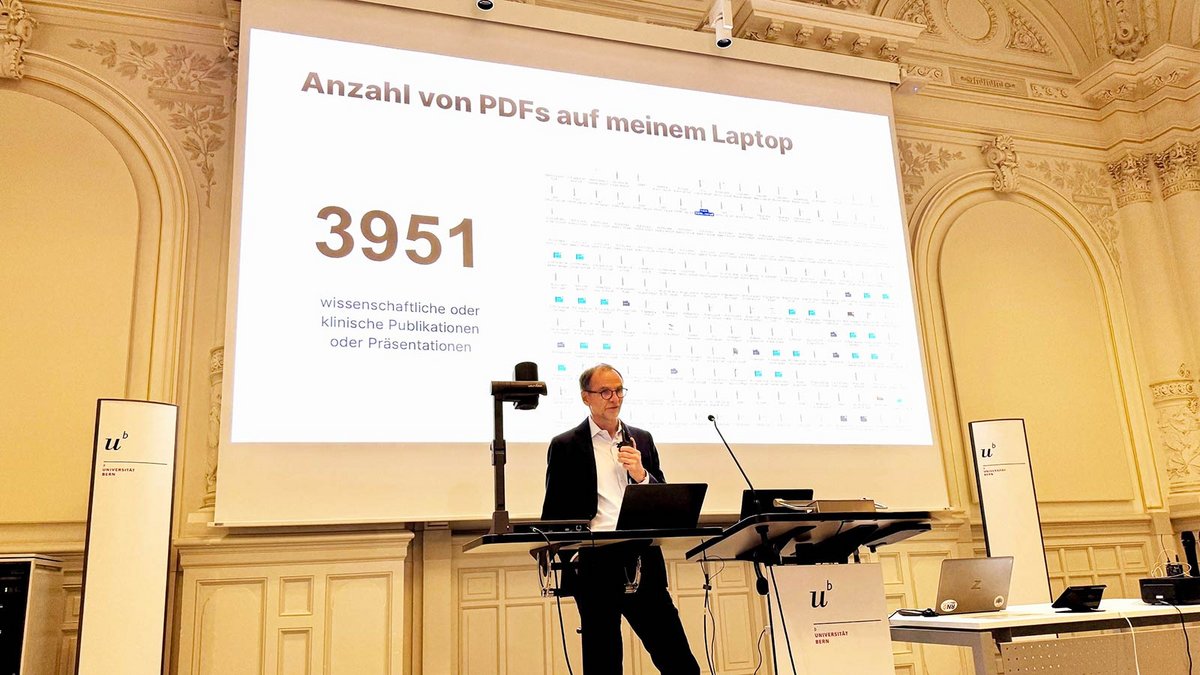
The result: knowledge is no longer internalized in a lasting way, but rather collected. «We collect bundles of information,» said Raabe. He noted that his own laptop contains thousands of PDFs of scientific papers—yet only a fraction of the content is actually relevant. This «hidden knowledge» often remains locked away in documents.
From files to topics: A new understanding of knowledge
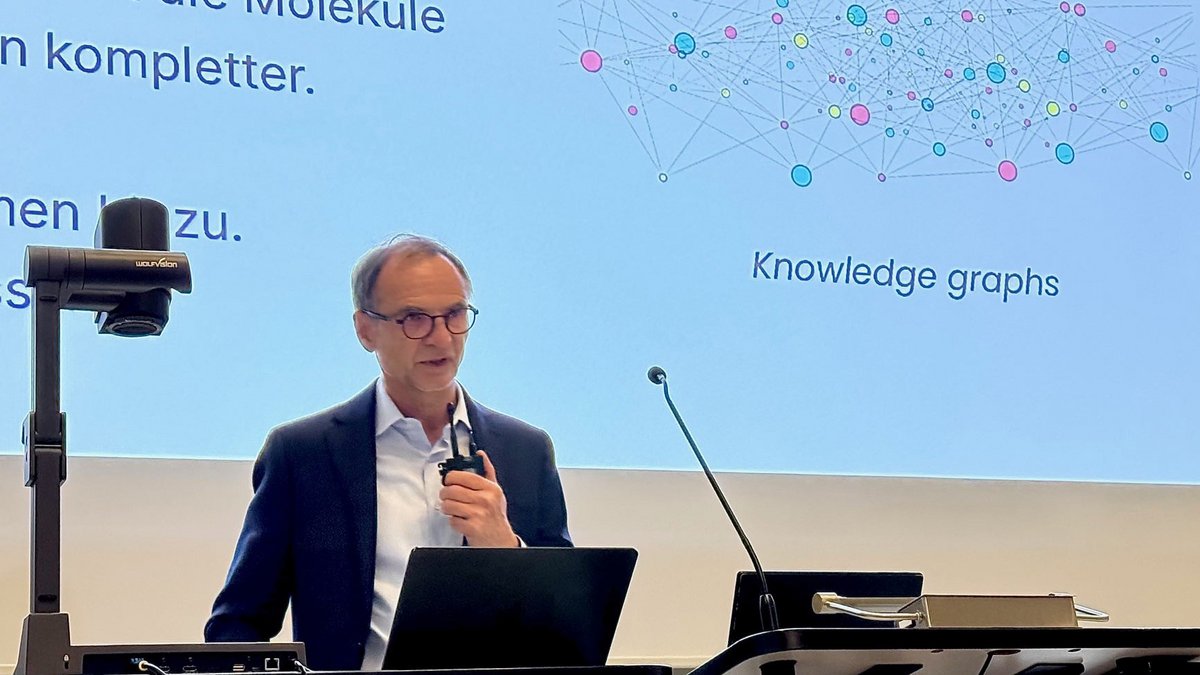
Andreas Raabe therefore called for a fundamental shift in perspective: away from individual files and toward knowledge structured by content. Instead of isolated documents, he argued, we need «knowledge atoms» that can be combined into «knowledge molecules»—that is, contextualized, relevant units of information.
AI as a filter and thinking partner
This is where Andreas Raabe sees the central role of artificial intelligence. It can help filter and organize information that is relevant to the individual and present it in the right context.
«AI is coming; it’s important—we have to get on board and steer it toward what we need,» he emphasized.
When used correctly, AI will:
- personalize knowledge
- filter information overload
- highlight new content in a targeted manner
- act as a partner in thinking
The goal is a transition from static content to dynamic, context-based learning. In line with the «Extended Mind» theory, digital systems become an extended cognitive space: they not only provide information but also help structure, organize, and apply knowledge.
Specific application: Elumity
At the conclusion of his presentation, Andreas Raabe introduced a project that brings his previously outlined vision to life: the software Elumity. What began as a research project at Inselspital Bern is now being further developed as a spin-off and is currently in the beta stage. The idea behind it: no longer storing knowledge in isolated PDFs, but making it accessible via AI that understands, links, and provides content in the right context. With the «AI Dialog» feature integrated into the program, it aims to address precisely what was identified as the core problem in the presentation: the targeted use of relevant knowledge from large amounts of data.
Brain Week 2026, University of Bern
Brain Week is an international series of events dedicated to raising awareness about the brain, its functions, and related disorders. Brain Week in Bern is organized by the Clinical Neurosciences (CNB) at the University of Bern. It offers a diverse program featuring lectures, film screenings, and panel discussions aimed at a broad audience—from experts to interested laypeople. Topics range from memory and consciousness to mental health and current advances in brain research.
View the full program for Brain Week 2026 (German language)
Related News
- Brain Week 2025 – Panel discussion «Myth or Reality»17.03.25 - Brain Week Bern traditionally concludes with the popular panel discussion. In the well-attended auditorium of the University of Bern, there were…
- Truth or myth – Brain week 202419.03.24 - At the end of Brain Week, provocative theses were discussed by leading figures in neurosurgery and neurology from Inselspital, Bern University…
- Is a robot a better surgeon?23.03.23 - Robotics has long since found its way into medicine. Robotic surgery is part of everyday surgical practice. But can humans be replaced entirely?